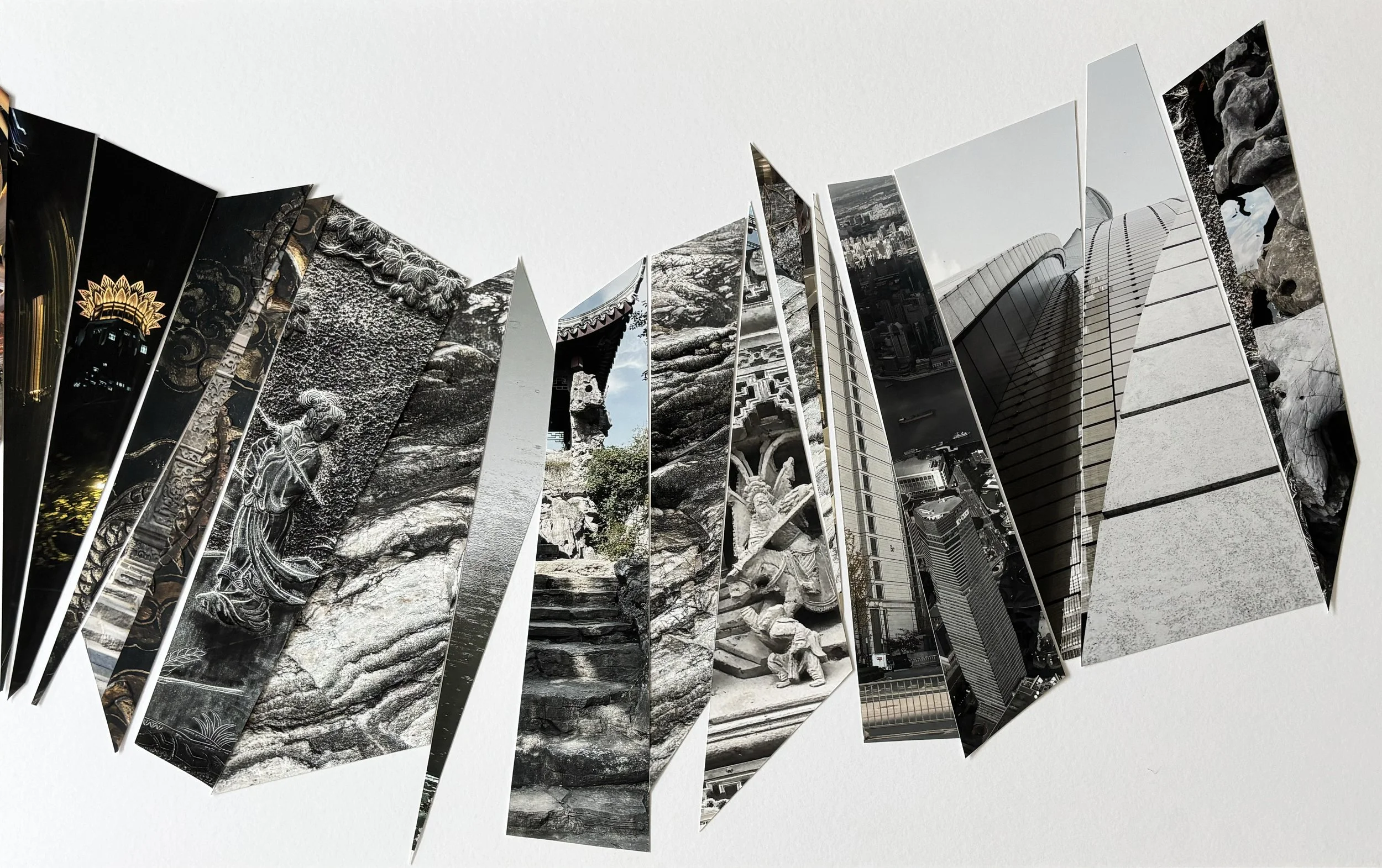
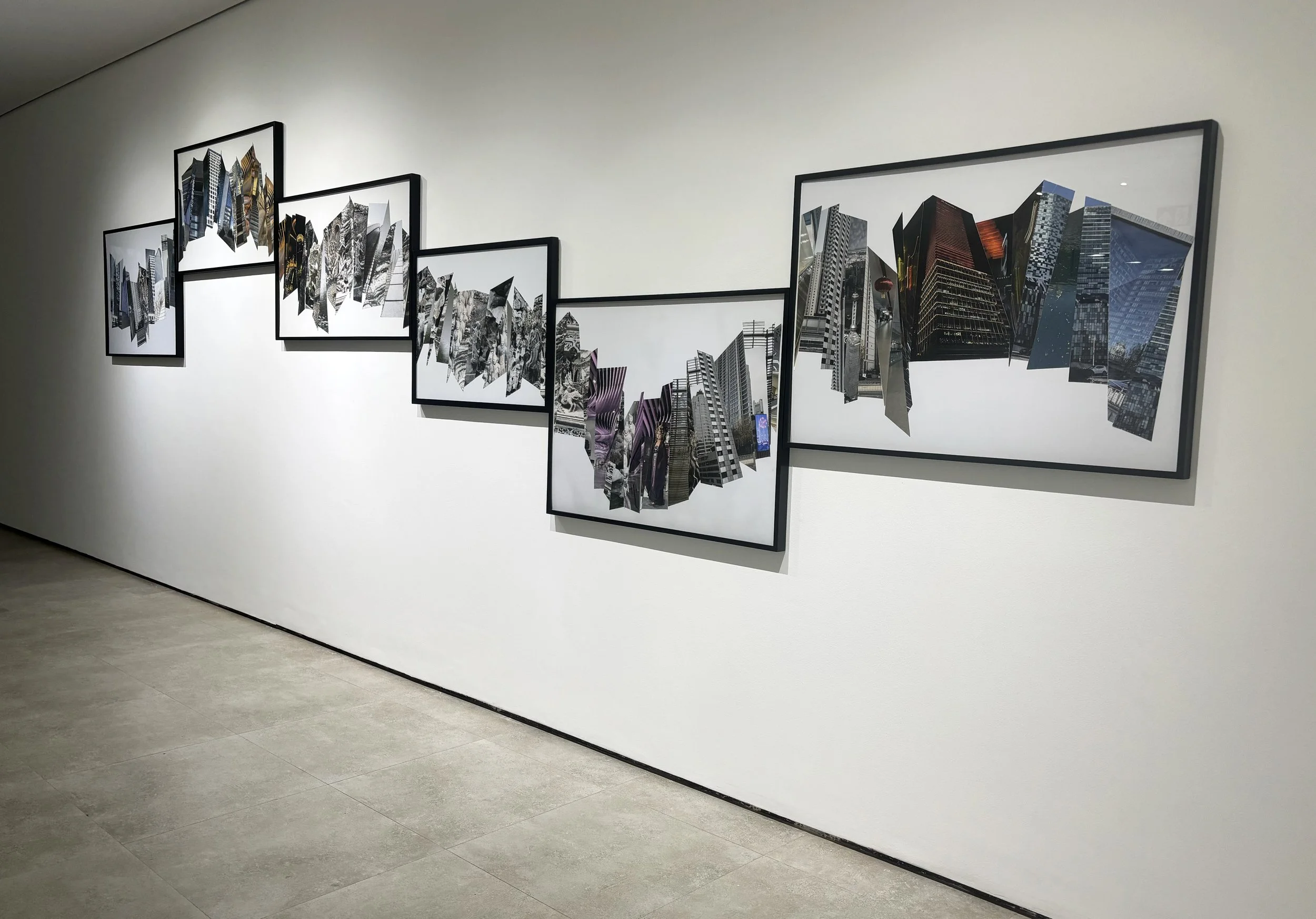
Arquitexturas is grounded in two constitutive elements of Chinese tradition — water and rock — understood not as opposites, but as complementary forces that symbolically structure the cultural landscape. By mobilizing them, I propose to place them in dialogue and friction with a present marked by accelerated industrialization, expansionist urbanism, and the emergence of new technologies.The research develops from a desire to explore how such forces, which for centuries have shaped aesthetic thought, philosophy, and the construction of space in China, persist and transform in the face of a hyper-technological reality in constant mutation. Rather than treating tradition and modernity as separate fields, the work turns to their zones of contact and contamination, where traces of a symbolic landscape infiltrate the urban and digital fabric. The contemporary Chinese city, with its monumental infrastructures, industrial spaces, and digital architectures coexisting with historical temples, thus emerges as a complex field of entanglements in which the old and the new are interwoven across multiple layers.Resulting from an artistic residency in Shanghai, the works are constituted through experimentations with expanded photography and video — media that allow for the tensioning of spatial relations and non-linear temporalities. The image is conceived as a field of flows, in which past and present coexist without fully merging, generating zones of interiority, rhythms, and transformations. The fold, as a figure of continuity and internal multiplicity, operates as a structuring principle of these landscapes, in planes that bend and remain in tension.Landscape, here, is understood as “a material work of the mind” (BRUNO, 2014, p. 19): something that exists as a mental construction, a form the mind projects onto matter, while at the same time remaining a sensorial reality experienced materially. It is matter mediated by perception, imagination, and culture. In the Chinese tradition, shanshui (山水, shān shuǐ), literally “mountain and water,” designates a classical genre of landscape painting that goes beyond the mere depiction of the physical world, incorporating philosophical, spiritual, and poetic dimensions, deeply informed by Taoism, Confucianism, and Chan (Zen) Buddhism. In this sense, the notion of landscape as a “material work of the mind” can be read differently: within Chinese thought, landscape has never been merely a representation of nature, but rather a field that is simultaneously spiritual, mental, and aesthetic. For the traditional Chinese painter, landscape has always already been a material operation of the mind.Arquitexturas, drawing from the experience lived on Chinese soil, articulates the intention of folding matter and mind into a single surface. It seeks to explore the visual as a manifestation of frames of the mind, approaching the perception of textures as a surface-landscape. Ultimately, it proposes to think of the image as texture. (BRUNO, 2014, p. 15) _______________________Arquitexturas parte de dois elementos constituintes da tradição chinesa — a água e a rocha — compreendidos não como opostos, mas como forças complementares que estruturam simbolicamente a paisagem cultural. Ao mobilizá-los, proponho colocá-los em diálogo e fricção com um presente marcado pela industrialização acelerada, pelo urbanismo expansionista e pela emergência de novas tecnologias.A pesquisa se desenvolve do desejo de explorar como tais forças, que por séculos moldaram o pensamento estético, a filosofia e a construção do espaço na China, persistem e se transformam diante de uma realidade hipertecnológica e em constante mutação. Em vez de tratar tradição e modernidade como campos estanques, o trabalho se volta às suas zonas de contato e contaminação, onde vestígios da paisagem simbólica se infiltram no tecido urbano e digital. A cidade chinesa contemporânea, com suas infraestruturas monumentais, seus espaços industriais e suas arquiteturas digitais coexistindo com templos históricos, emerge, assim, como um campo complexo de entrelaçamentos, no qual o antigo e o novo se enredam em múltiplas camadas.Resultantes de uma residência artística em Shanghai, os trabalhos se constituem a partir de experimentações com a fotografia expandida e o vídeo, meios que permitem tensionar relações espaciais e temporalidades não lineares. A imagem é concebida como um campo de fluxos, no qual passado e presente coexistem sem se fundir, instaurando zonas de interioridade, ritmos e transformações. A dobra, enquanto figura da continuidade e da multiplicidade interna, opera como princípio estruturante dessas paisagens, em planos que se curvam e se tensionam.Paisagem, aqui, é compreendida como "a material work of the mind" (BRUNO, 2014, p.19), algo que existe como uma construção mental, uma forma que a mente projeta sobre a matéria e, ao mesmo tempo, uma realidade sensível que se dá na experiência. É matéria mediada pelo olhar, pelo imaginário e pela cultura. Na tradição chinesa, shanshui (山水, shān shuǐ), literalmente “montanha e água”, designa um gênero clássico da pintura da pintura de paisagem que ultrapassa a simples descrição do mundo físico, incorporando dimensões filosóficas, espirituais e poéticas, profundamente marcadas pelo taoismo, confucionismo e budismo chan (zen). Assim, na percepção chinesa, paisagem compreendida como "a material work of the mind" pode ser lida de outro modo: lá, a paisagem nunca foi apenas representação da natureza, mas um campo espiritual, mental e estético ao mesmo tempo. Para um pintor chinês tradicional, a paisagem já era, desde sempre, um trabalho material da mente.Arquitexturas, a partir da experiência vivida em solo chinês, traduz a intenção de dobrar matéria e mente numa única superfície. Interessa explorar o visual como manifestação de frames da mente, tratar a percepção das texturas como paisagem da superfície. Em última instância, pensar a imagem como textura. (BRUNO, 2014, p.15)arquitexturas I, 2024/2025
photoinstallation, 140 x 620 cm NAC Gallery — UFRN, 2025. Natal, RN, Brazil. Solo show. (Exhibition held in the context of the launch of the China-Latin America Alliance for Music and Arts ACALMA, partnership between UFRN and ZISU/Hangzhou — exposição realizada no contexto do lançamento da Aliança China–América Latina de Música e Artes ACALMA, parceria UFRN e ZISU/Hangzhou).